
Income Tax Notice Received? Don’t Panic—Act Strategically
Receiving an income tax notice can be unsettling.
You may receive an email or SMS stating that an action is required on your income tax account. The communication may refer to a mismatch in income, tax deducted at source, Annual Information Statement (AIS), a defective return, outstanding demand, verification of transactions, or detailed scrutiny of your tax return.
The first reaction of many taxpayers is either panic or procrastination.
Both can be costly.
An income tax notice does not automatically mean that you have committed a tax offence or that additional tax is payable. In many cases, the notice is simply a request for clarification, correction, confirmation, or additional information. However, ignoring the notice can turn a manageable compliance issue into a much more serious tax dispute.
That is why the first seven days after receiving an income tax notice are critical.
Your objective during this period should not necessarily be to immediately draft and submit a reply. Your first objective should be to understand the notice, verify its authenticity, identify the issue, establish the deadline, gather evidence and determine the appropriate response strategy.
The Income Tax Department provides an electronic e-Proceedings facility through which taxpayers can view and respond to several notices, intimations and communications.
This guide explains what to do when an income tax notice is received, particularly during the first seven days.
Important: Tax laws, procedures and section references can change. Since the Income-tax Act, 2025 and Income-tax Rules, 2026 have introduced a new legislative framework from the relevant tax year, while proceedings relating to earlier years may continue under the Income-tax Act, 1961, taxpayers should always identify the applicable law and tax year before responding. ICAI has published a tabular mapping between the Income-tax Act, 2025 and the earlier 1961 Act.
What Is an Income Tax Notice?
An income tax notice is an official communication issued by the Income Tax Department, Centralised Processing Centre (CPC), Assessing Officer or another competent tax authority asking the taxpayer to take a specified action.
Depending on the circumstances, the communication may:
- seek clarification;
- request documents or information;
- point out an apparent mismatch;
- identify a defect in the income tax return;
- propose an adjustment;
- require verification of transactions;
- communicate an outstanding demand;
- initiate assessment or reassessment proceedings;
- require attendance or information;
- or communicate the result of tax processing or assessment.
The word “notice” therefore covers a broad range of situations.
An income tax notice received by a salaried employee may be very different from one received by a businessman, professional, company, investor, HNI, NRI or trust.
The correct response depends on the exact section, tax year, issue raised and deadline stated in the communication.
Why the First 7 Days After an Income Tax Notice Matter
The first seven days should be treated as a tax-response triage period.
You need to answer five fundamental questions:
- Is the communication genuine?
- What exactly is the Department asking?
- Which tax year and return does it relate to?
- What is the response deadline?
- What evidence is required to support the response?
A common mistake is to open the notice, read one paragraph, become anxious and immediately send a short response such as:
“There is no discrepancy. Please close the matter.”
That may not be sufficient.
A good tax response is generally fact-based, document-supported and legally appropriate.
The Income Tax Department’s e-Proceedings facility allows taxpayers to view notices and submit responses electronically. The Department also advises taxpayers to retain the transaction ID/acknowledgement generated after successful submission.
Income Tax Notice First 7 Days: A Day-by-Day Action Plan
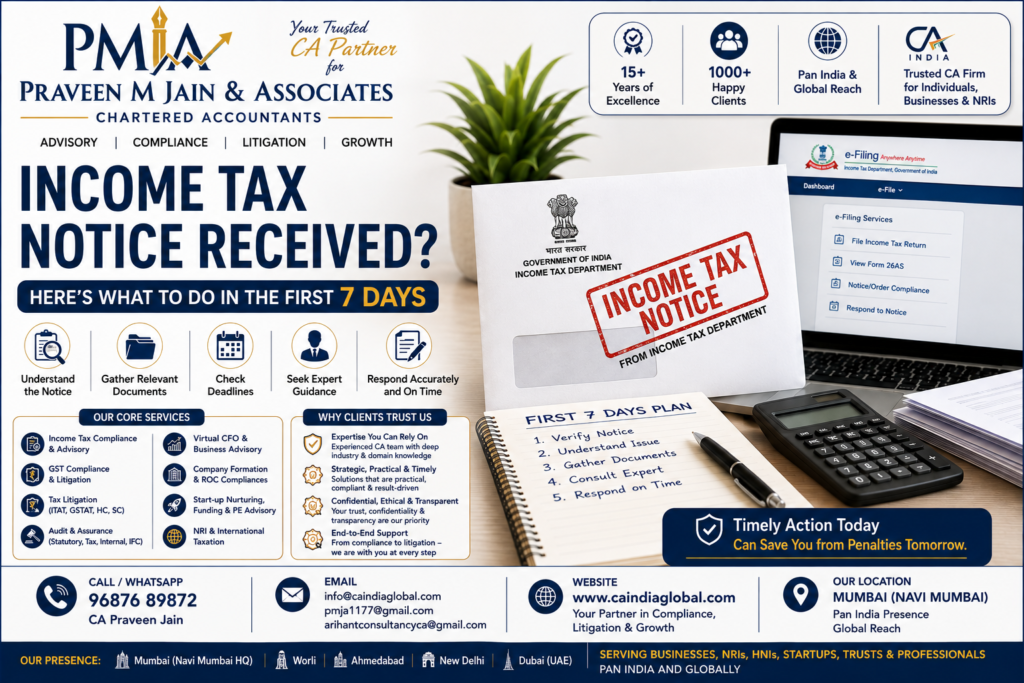
Here is a practical income tax notice first 7 days action plan.
Day 1: Don’t Panic—Verify the Notice
The first step is authentication.
Do not rely only on the email or SMS that you received.
Log in independently to the official Income Tax e-Filing portal rather than clicking an unknown link contained in an email.
Check:
- PAN;
- taxpayer name;
- Assessment Year or applicable Tax Year;
- notice date;
- DIN;
- section under which the communication has been issued;
- issuing authority;
- response due date;
- subject matter;
- document/reference number;
- attachments;
- and whether the communication appears under your pending actions/e-Proceedings.
The Income Tax Department provides an Authenticate Notice/Order Issued by ITD facility. Communications issued by the Income Tax Department on or after 1 October 2019 are generally required to bear a unique Document Identification Number (DIN), subject to applicable exceptions. The Department states that a communication without the required DIN may be treated as invalid in specified circumstances.
What should you do?
Create a folder immediately:
Income Tax Notice – AY/Tax Year – PAN
Save:
- original notice PDF;
- email received;
- SMS screenshot, if relevant;
- acknowledgement;
- previous ITR;
- computation;
- supporting documents;
- subsequent correspondence;
- and proof of every response submitted.
This simple practice can become extremely valuable if the matter continues into assessment, appeal or litigation.
Day 2: Identify the Type of Income Tax Notice
The second day should focus on classification.
Not every communication from the Income Tax Department has the same legal significance.
Some communications are routine processing matters. Others may require detailed representation.
Here are some commonly encountered categories.
1. Intimation Under Section 143(1)
A communication under the earlier Income-tax Act, 1961 framework relating to processing of the return under section 143(1) is generally an intimation of processing, rather than a conventional scrutiny notice.
It may show:
- income accepted by CPC;
- tax liability;
- refund;
- interest;
- adjustment;
- mismatch;
- or other processing-related changes.
If the taxpayer believes an adjustment is incorrect, the appropriate remedy may involve examining the intimation, responding to a proposed adjustment where applicable, or considering rectification/other remedies depending upon the facts.
Do not assume that every 143(1) communication means that the Department has “opened scrutiny.”
2. Defective Return Notice Under Section 139(9)
https://www.incometax.gov.in/iec/foportal/help/respond-to-e-proceedings
A notice under section 139(9) generally means that the Department considers the return defective because of an incomplete or inconsistent return or related information.
Examples can include:
- TDS credit claimed but corresponding income not disclosed;
- mismatch between receipts and TDS information;
- incorrect taxpayer details;
- incomplete financial statements;
- inconsistencies in schedules;
- business/professional income reported without required financial information.
The Department states that a taxpayer generally receives 15 days from receipt of the defective notice, or the period specified in the notice, to rectify the defect, with the possibility of seeking an extension/adjournment in appropriate cases.
This is a notice that should not be ignored.
Failure to respond can result in the return being treated as invalid, with consequential tax and compliance implications.
3. Notice Under Section 142(1)
A notice under section 142(1) of the Income-tax Act, 1961 framework may require the taxpayer to:
- furnish information;
- produce documents;
- provide accounts;
- explain transactions;
- furnish a return in specified circumstances;
- or provide other information relevant to assessment.
This type of notice deserves careful attention because the Department may be seeking information before completing an assessment.
A response should normally address each question separately.
If the notice asks ten questions, avoid giving a two-paragraph generic reply.
Use:
Query 1 – Response
Query 2 – Response
Query 3 – Response
and attach supporting evidence.
4. Notice Under Section 143(2)
A notice under section 143(2) historically indicates selection of a return for scrutiny assessment under the Income-tax Act, 1961 framework.
This is significantly more important than a routine processing intimation.
The taxpayer should immediately examine:
- issues selected for scrutiny;
- return filed;
- computation;
- books;
- financial statements;
- AIS;
- Form 26AS;
- bank statements;
- investment records;
- property transactions;
- capital gains;
- loans;
- related-party transactions;
- and all other relevant evidence.
A professional tax review is strongly advisable where the scrutiny involves substantial amounts or complex transactions.
5. Notice Relating to Reassessment
A reassessment-related communication is potentially more serious because it concerns income that the Department believes may have escaped assessment or requires reassessment under the applicable law.
Such notices should not be answered casually.
The taxpayer should first examine:
- jurisdiction;
- limitation;
- statutory conditions;
- information relied upon;
- procedural requirements;
- opportunity granted;
- factual basis;
- and whether the Department has correctly identified the taxpayer or transaction.
Where the notice has potentially significant tax exposure, obtain professional advice before submitting a substantive response.
6. Outstanding Demand / Demand Notice
Sometimes a taxpayer receives a communication showing that tax is payable.
The first question should be:
Is the demand actually correct?
Do not automatically pay a demand merely because it appears on the portal.
Compare the demand with:
- ITR;
- intimation;
- assessment order;
- tax payments;
- TDS/TCS;
- advance tax;
- self-assessment tax;
- previous rectification;
- appeal orders;
- and any stay granted.
If the demand is incorrect, the appropriate response may involve rectification, response to outstanding demand, appeal, stay application or another remedy depending on the facts.
7. Compliance / e-Verification / Information Request https://www.incometax.gov.in/iec/foportal/help/how-to-authenticate-notice
A taxpayer may also receive communication requiring verification of information or transactions.
These may relate to:
- high-value transactions;
- property purchases;
- securities;
- bank transactions;
- foreign assets;
- foreign income;
- TDS;
- SFT information;
- or other data reported to the Income Tax Department.
The Compliance Portal provides facilities for taxpayers to respond to certain e-Campaigns, e-Verification and e-Proceedings.
Day 3: Understand Why the Notice Was Issued
Once the notice is authenticated and classified, identify the trigger.
This is one of the most important steps in understanding how to respond to an income tax notice.
Ask:
Is there an AIS mismatch?
For example:
AIS shows: ₹20 lakh
ITR shows: ₹15 lakh
That does not automatically mean undisclosed income.
The difference may represent:
- duplicate reporting;
- incorrect SFT information;
- gross receipts versus taxable income;
- exempt income;
- sale consideration;
- joint ownership;
- cancelled transaction;
- or another reporting issue.
The response should explain the difference with evidence.
AIS and Form 26AS Should Be Reviewed Before Responding
https://caindiaglobal.com/why-tax-filing-matters/
Before preparing the reply, compare:
- ITR;
- Form 26AS;
- AIS;
- TIS;
- bank statements;
- Form 16;
- TDS certificates;
- broker statements;
- property documents;
- loan statements;
- and accounting records.
This is particularly important for taxpayers with:
- multiple bank accounts;
- investments;
- property transactions;
- foreign income;
- business income;
- capital gains;
- freelance/professional receipts;
- or several sources of TDS.
Day 4: Build Your Document File
The fourth day should be dedicated to evidence.
A tax notice should be treated like a documentary evidence exercise, not simply a letter-writing exercise.
Depending on the issue, collect:
Income Documents
- Form 16;
- salary slips;
- professional receipts;
- invoices;
- commission statements;
- interest certificates;
- dividend statements;
- rental income records.
Tax Documents
- ITR acknowledgement;
- computation of income;
- Form 26AS;
- AIS;
- TIS;
- TDS certificates;
- advance-tax challans;
- self-assessment tax challans.
Bank and Financial Records
- bank statements;
- loan statements;
- credit-card statements where relevant;
- investment account statements;
- demat statements;
- mutual fund statements.
Property Documents
- sale deed;
- purchase agreement;
- stamp-duty details;
- registration documents;
- payment proof;
- capital-gain computation.
Business Records
- financial statements;
- ledgers;
- invoices;
- GST returns;
- e-invoices;
- bank statements;
- stock records;
- expense documentation.
Foreign Asset / Income Records
Where applicable:
- foreign bank statements;
- broker statements;
- foreign tax documents;
- remittance records;
- foreign asset details;
- tax residency documents.
Day 5: Prepare an Issue-Wise Reconciliation
This is where the response begins to take shape.
Create a simple reconciliation matrix.
| Department’s Observation | Taxpayer’s Position | Supporting Evidence | Proposed Response |
| AIS income ₹25 lakh | Actual taxable income ₹18 lakh | AIS + bank + books | Explain difference |
| TDS ₹2 lakh | Income already disclosed | Form 26AS + ITR | Reconcile |
| Property transaction | Jointly owned property | Sale deed | Explain ownership |
| Bank deposit ₹10 lakh | Loan received | Loan agreement + bank statement | Explain source |
| Capital gain mismatch | Different transaction dates | Broker statement | Recompute |
This approach prevents a common mistake: writing the reply before understanding the facts.
Day 6: Decide Whether You Need a Tax Professional
Not every income tax notice requires a Chartered Accountant or tax lawyer.
However, professional assistance becomes particularly valuable where the notice involves:
- large tax demand;
- scrutiny assessment;
- reassessment;
- undisclosed income allegations;
- unexplained cash credits;
- unexplained investments;
- property transactions;
- foreign assets;
- HNI transactions;
- business/professional income;
- complex capital gains;
- related-party transactions;
- search or survey-related matters;
- penalty proceedings;
- prosecution exposure;
- or repeated notices.
A professional can help with three separate tasks:
1. Factual analysis
What actually happened?
2. Tax/legal analysis
What does the law say?
3. Representation strategy
What should be disclosed, explained, challenged or supported?
These are different questions.
Day 7: Submit the Correct Response
The seventh day should ideally be about finalisation and submission, rather than discovering the notice for the first time.
The response should:
- identify the notice;
- identify the relevant tax year;
- acknowledge the issue;
- respond to each query;
- explain the facts;
- cite supporting documents;
- provide reconciliations;
- make the appropriate legal submission where required;
- upload supporting documents;
- submit within the prescribed deadline;
- save the acknowledgement/transaction ID.
The Department’s e-Proceedings system permits taxpayers to view notices, submit responses and upload supporting documents. For certain AO notices, the system provides options such as full or partial response and allows written remarks and document uploads.
The Department also states that, after submission, the response generally cannot be edited or withdrawn through the portal.
Therefore: review before clicking “Submit.”
How to Respond to an Income Tax Notice: A Practical Structure
A professional response can generally follow this structure:
1. Reference
Mention:
- notice number/DIN;
- date;
- section;
- Assessment Year/Tax Year.
2. Background
Briefly explain the taxpayer and relevant transaction.
3. Issue-wise Response
Respond separately to each observation.
4. Documentary Evidence
Refer to attachments clearly.
For example:
“The amount of ₹8,50,000 represents a housing loan received from XYZ Bank. A copy of the sanction letter and bank statement evidencing the receipt are enclosed as Annexure 2.”
5. Reconciliation
Where a mismatch exists, provide a table.
6. Legal Position
Where necessary, explain the applicable statutory provision.
7. Prayer / Request
Conclude with a clear request, such as:
“In view of the above facts and supporting documents, it is respectfully requested that the proposed adjustment may kindly be dropped.”
Practical Example 1: AIS Shows Higher Income
Suppose a salaried taxpayer receives an income tax notice stating:
AIS reported income: ₹18 lakh
Income reported in ITR: ₹13 lakh
The taxpayer immediately assumes there is a tax problem.
But further analysis reveals:
- ₹5 lakh represents sale consideration of mutual fund units;
- the taxpayer has already reported the resulting capital gain;
- the AIS transaction is reporting the gross sale value, not taxable income.
Correct approach
Do not simply say:
“AIS is wrong.”
Instead:
- obtain AIS;
- identify the transaction;
- obtain broker/mutual fund statement;
- reconcile purchase cost;
- calculate capital gain;
- verify ITR disclosure;
- explain the difference;
- attach documentary evidence.
This is a classic example of why how to respond to income tax notice depends on the underlying transaction, not merely the amount appearing in AIS.
Practical Example 2: TDS Mismatch
Suppose Form 26AS shows TDS of ₹1,20,000.
The taxpayer claimed the entire TDS credit.
However, the Department identifies that the corresponding receipt was not reported in the return.
The taxpayer explains:
- the receipt was actually included in professional income;
- the payer’s reporting contains a different description;
- the gross receipt appears in the books;
- GST invoice and bank receipt support the transaction.
The correct response should provide a reconciliation rather than simply saying:
“TDS is appearing in 26AS, therefore my claim is correct.”
The Department may be examining both income disclosure and TDS credit.
Practical Example 3: Property Transaction
A taxpayer receives a notice relating to a ₹75 lakh property transaction.
The taxpayer is worried because the ITR does not show ₹75 lakh as income.
But the amount represents sale consideration, not necessarily taxable income.
The taxpayer should produce:
- purchase deed;
- sale deed;
- ownership details;
- purchase cost;
- improvement expenditure;
- stamp valuation;
- capital-gain computation;
- exemption details, if any;
- and bank transaction trail.
Again, the correct approach is to distinguish transaction value from taxable income.
Practical Example 4: Large Bank Deposit
A taxpayer receives a notice regarding ₹12 lakh deposited into a bank account.
The deposit may represent:
- transfer from another own bank account;
- loan;
- sale proceeds;
- business receipts;
- redemption of investment;
- gift;
- or another legitimate source.
The answer cannot simply be:
“The amount is genuine.”
The taxpayer must explain the source and nature of the deposit and provide evidence.
Common Mistakes After Receiving an Income Tax Notice
Mistake 1: Ignoring the Notice
This is perhaps the most dangerous mistake.
Not receiving a physical letter does not necessarily mean that no action is required.
Taxpayers should regularly check:
- registered email;
- SMS;
- e-Filing portal;
- Pending Actions;
- e-Proceedings;
- Compliance Portal.
The Department’s portal provides e-Proceedings for viewing and responding to various communications.
Mistake 2: Responding at the Last Minute
https://caindiaglobal.com/nri-tax-return-india-guide/
Last-minute responses create several risks:
- documents may be incomplete;
- reconciliation may not be finished;
- professional review may not be possible;
- portal issues may arise;
- the response may contain factual errors.
Start immediately.
Mistake 3: Sending an Emotional Reply
Tax proceedings should be handled professionally.
Avoid statements such as:
“Your department is harassing me.”
or:
“I have always paid tax, so this notice is unnecessary.”
Instead, establish the facts and evidence.
Mistake 4: Giving Too Much Unnecessary Information
More information is not always better.
A response should be:
complete but focused.
Do not volunteer unrelated transactions unless there is a reason to do so.
Mistake 5: Giving Too Little Information
The opposite mistake is equally problematic.
A response such as:
“The transaction is genuine.”
may not establish anything.
Explain:
- what happened;
- when;
- amount;
- parties involved;
- source;
- accounting treatment;
- tax treatment;
- and supporting evidence.
Mistake 6: Uploading Documents Without Explanation
Uploading 50 pages of bank statements without identifying the relevant transaction is not an effective response.
Use document references:
Annexure 1 – Bank statement
Page 12 – Credit of ₹8,50,000 on 15 June
Annexure 2 – Loan agreement
Page 4 – Loan sanction details
Make the officer’s job easier.
Mistake 7: Treating Every Notice as a Tax Demand
A notice requesting information is not necessarily a demand for payment.
A taxpayer should distinguish between:
- information request;
- proposed adjustment;
- defective return;
- scrutiny;
- assessment;
- reassessment;
- demand;
- penalty;
- and appealable order.
The remedy depends on the nature of the communication.
Mistake 8: Ignoring the Tax Year
Always confirm the relevant:
- Assessment Year;
- Financial Year;
- or Tax Year, as applicable under the current law.
A taxpayer may have multiple proceedings for different years.
Documents and legal provisions applicable to one year may not automatically apply to another.
Mistake 9: Assuming That a CA’s Earlier Return Filing Eliminates Risk
Even where the ITR was prepared by a professional, the taxpayer remains responsible for providing accurate information and responding to subsequent communications.
If a notice arises from an omission or mismatch, the taxpayer should work with the professional who prepared the return where appropriate.
Mistake 10: Ignoring Earlier Notices
Sometimes the notice received today is not the first communication.
Check the history of:
- previous notices;
- responses;
- adjournment requests;
- orders;
- rectification;
- appeals;
- and outstanding demands.
The current notice may be a continuation of an earlier proceeding.
Income Tax Notice Response Checklist
Before submitting your reply, verify the following:
- Notice authenticated.
- DIN checked.
- PAN and taxpayer name verified.
- Assessment Year/Tax Year verified.
- Notice section identified.
- Response deadline noted.
- Notice downloaded and saved.
- ITR acknowledgement obtained.
- Computation reviewed.
- Form 26AS reviewed.
- AIS/TIS reviewed.
- Bank statements reviewed.
- Relevant documents collected.
- Department’s observations listed issue-wise.
- Reconciliation prepared.
- Supporting evidence indexed.
- Legal position reviewed where necessary.
- Professional opinion obtained where appropriate.
- Response reviewed before submission.
- Response submitted through appropriate portal.
- Transaction ID/acknowledgement saved.
- Complete response file archived.
When Should You Consult a Chartered Accountant or Tax Lawyer?
https://caindiaglobal.com/foreign-assets-in-ais-fa-disclosure/
Professional advice is particularly recommended where the income tax notice involves material financial exposure or legal complexity.
Consider professional assistance if:
The notice relates to scrutiny
A scrutiny assessment requires a structured response strategy.
The notice concerns reassessment
Jurisdiction, limitation and procedural issues may become important.
There is an unexplained investment allegation
The source and documentary trail should be carefully established.
There is an unexplained cash-credit issue
Bank statements alone may not be enough. The identity, creditworthiness and genuineness of the transaction may need examination depending on the provision involved.
There are foreign assets or income
International tax rules, reporting requirements, treaty provisions and disclosure schedules may become relevant.
There are substantial capital gains
Property, shares, securities and other investments can involve detailed tax computations.
There is a substantial outstanding demand
The taxpayer should determine whether the demand is payable, incorrect, already paid, stayed, appealable or rectifiable.
Penalty proceedings have started
Penalty proceedings should not be treated as a routine clarification.
What If You Cannot Respond Within the Deadline?
Do not simply wait until the deadline expires.
The Income Tax Department’s e-Proceedings functionality allows taxpayers, in applicable proceedings, to seek an adjournment/extension. The exact availability depends on the type and status of the proceeding.
If additional time is genuinely required:
- identify why the response cannot be completed;
- gather evidence of the reason where appropriate;
- submit an extension/adjournment request promptly;
- explain the time required;
- continue preparing the substantive response.
Never assume that silence is an extension.
What If You Already Missed the Deadline?
If you have already missed the deadline, do not conclude that the matter is automatically lost.
Immediately:
- log into the e-Filing portal;
- check the proceeding status;
- determine whether response functionality remains available;
- examine whether an extension/adjournment can be requested;
- check whether an order has already been passed;
- determine whether rectification, appeal or another remedy is available;
- consult a tax professional if the matter is material.
The correct remedy depends heavily on the stage of the proceeding.
Income Tax Notice and Legal Rights of the Taxpayer
Receiving a notice does not mean that the Department’s position is automatically correct.
Taxpayers may have legitimate grounds to:
- explain facts;
- provide evidence;
- dispute a proposed adjustment;
- request clarification;
- seek additional time where legally permissible;
- seek rectification;
- file an appeal;
- challenge jurisdiction;
- or pursue other remedies available under the applicable law.
Recent tax jurisprudence continues to demonstrate the importance of procedural compliance and natural justice. For example, ICAI’s 2026 legal-decision updates record cases dealing with issues such as inadequate opportunity and defective statutory communications.
However, taxpayers should not rely on a general statement such as “the notice is invalid.” Any challenge to jurisdiction or procedure must be examined against the specific facts, applicable statute, notice and stage of proceedings.
The Golden Rule: Evidence First, Explanation Second
A strong income tax notice response is usually built on three layers:
Layer 1: Facts
What actually happened?
Layer 2: Evidence
What documents prove it?
Layer 3: Law
How should the transaction be treated under the applicable tax provisions?
For example:
Fact: ₹20 lakh received from another person.
Evidence: Loan agreement + bank statement + repayment terms.
Law: Applicable provisions relating to the nature and tax treatment of the transaction.
This framework is far stronger than a generic denial.
A Simple “Notice Response Formula”
For taxpayers who are unfamiliar with tax proceedings, remember:
VERIFY → UNDERSTAND → RECONCILE → DOCUMENT → RESPOND → RECORD
VERIFY
Is the notice genuine?
UNDERSTAND
What exactly is being asked?
RECONCILE
Can you match the Department’s data with your records?
DOCUMENT
What evidence supports your position?
RESPOND
Submit a structured response within the prescribed deadline.
RECORD
Save the complete submission and acknowledgement.
SEO-Focused Questions Taxpayers Commonly Ask
What should I do after receiving an income tax notice?
First verify the notice through the official Income Tax e-Filing portal, identify the section and deadline, understand the issue, collect relevant documents and determine the appropriate response. Do not ignore the notice.
How do I respond to an income tax notice online?
Eligible notices can generally be accessed through Dashboard → Pending Actions → e-Proceedings on the Income Tax e-Filing portal. The taxpayer can view the communication and, where enabled, submit a response and supporting documents.
Is every income tax notice serious?
No. Some communications are routine processing or clarification matters, while others may initiate scrutiny, reassessment, penalty or other proceedings. The section, wording, issue and deadline must be examined.
What happens if I ignore an income tax notice?
Consequences depend on the type of notice. They can include an adverse assessment, invalidation of a defective return, loss of certain tax benefits, demand, penalty or other statutory consequences. For example, the Department specifically warns that failure to respond to a defective return notice can result in the return being treated as invalid.
Can I ask for more time?
In applicable proceedings, taxpayers may be able to seek an adjournment or extension through the available e-Proceedings functionality. Whether an extension is granted is case-specific.
Should I pay tax immediately after receiving a notice?
Not necessarily.
First determine whether the communication is:
- a demand;
- proposed adjustment;
- information request;
- assessment order;
- or another form of communication.
If there is a demand, reconcile it with your tax records before deciding what action is appropriate.
Can a Chartered Accountant respond to an income tax notice on my behalf?
The Income Tax e-Filing system provides mechanisms for authorised representatives to handle eligible proceedings. The Department’s e-Proceedings documentation specifically provides for an authorised representative in relevant cases.