
Table of Contents
- Introduction
- Quick Summary (TL;DR)
- Which ITR Form Applies to You
- Step-by-Step: Filing Online vs Hiring a CA
- ITR Filing Login: Credentials, OTP, DSC & Common Issues
- Documentation Checklist
- How to Compute Tax on Business Profit
- Presumptive Taxation vs Books-Based Taxation
- 8 Common Mistakes and How to Avoid Them
- ITR Filing Last Date, Extensions & What Happens If You Miss It
- Finding a Chartered Accountant Near You
- Using AIS to Reconcile Your Income
- FAQs
- Take Action
- Disclaimer
<a id=”introduction”></a>
Introduction
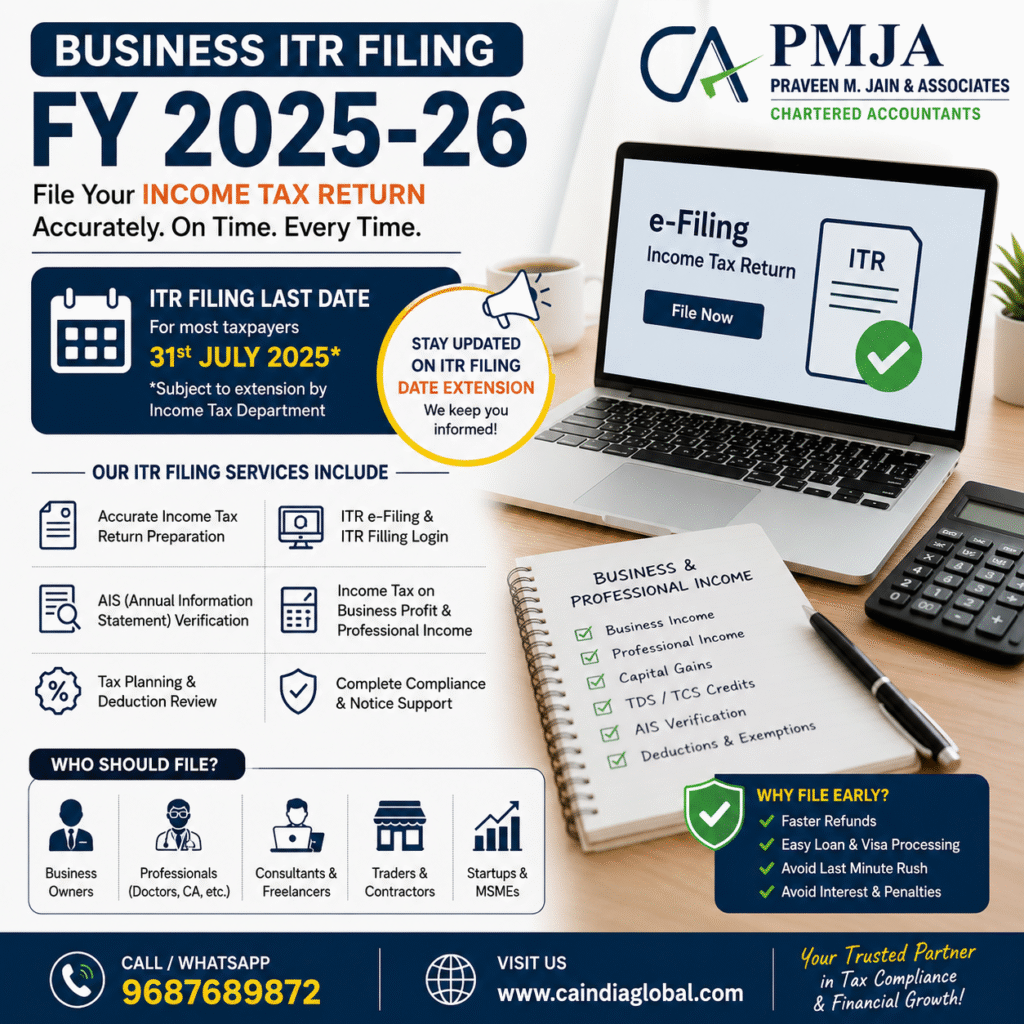
If you earn income from a business or profession, your ITR filing last date for FY 2025-26 (AY 2026-27) is 31 August 2026 — a full month after the deadline for salaried taxpayers. This later date applies specifically to individuals and HUFs filing ITR-3 or ITR-4 whose accounts do not require a tax audit. If your accounts are audited under Section 44AB, your deadline extends further to 31 October 2026.
This guide is written for freelancers, consultants, doctors, shop owners, traders, and small business proprietors who need clarity on income tax ITR filing — which form applies, how to use AIS to check your income data, what documents to gather, and whether it makes more sense to file yourself or bring in a Chartered Accountant. Whether you’re searching for “itr filling for professional income and business income online” or trying to figure out “in which form itr to be filled by individual having business and professional income,” this article walks through it step by step.
Bottom line: mark 31 August 2026 on your calendar now. Missing it means late fees, interest, and losing your right to carry forward business losses.
<a id=”quick-summary”></a>
Quick Summary (TL;DR)
- Who: Individuals/HUFs with business or professional income (non-audit cases)
- What: File ITR-3 (business/profession, books maintained) or ITR-4 (presumptive scheme)
- Due date: 31 August 2026 (31 October 2026 if audit applicable)
- Action now: Reconcile your AIS and Form 26AS, gather documents, and decide DIY vs CA-assisted filing
- Penalty for missing deadline: Late fee up to ₹5,000 under Section 234F, plus 1% monthly interest under Section 234A, and loss of carry-forward benefits for business losses
<a id=”which-form”></a>
Which ITR Form Applies to You
In which form itr to be filled by individual having business and professional income? It depends on how you maintain your accounts and your turnover:
- ITR-4 (Sugam): For individuals, HUFs, and firms (other than LLPs) with business or professional income who opt for the presumptive taxation scheme under Section 44AD, 44ADA, or 44AE, and whose total income is up to ₹50 lakh.
- ITR-3: For individuals and HUFs with income from business or profession who maintain regular books of accounts and do not opt for presumptive taxation, or whose income/turnover exceeds the presumptive limits. This form is also mandatory if you have income from intraday trading, F&O, or are a partner in a firm.
- ITR-2: Only if you have capital gains or multiple house properties but no business or professional income — not applicable if you’re running a business or practice.
If you’re unsure which category you fall into, this is one of the most common reasons taxpayers approach a Chartered Accountant — an incorrect form can lead to a defective return notice under Section 139(9).
<a id=”step-by-step”></a>
Step-by-Step: Filing Online vs Hiring a CA
Option A: Filing It Yourself Online (Itr E Filling)
- Log in to the Income Tax e-filing portal.
- Download or check your AIS and Form 26AS to reconcile TDS, interest income, and high-value transactions.
- Select the correct ITR form (ITR-3 or ITR-4) based on your accounting method.
- Enter business/professional income details — either presumptive income (6%/8% of turnover, or 50% of gross receipts for professionals) or actual profit as per your books.
- Claim eligible deductions under Chapter VI-A (80C, 80D, etc.) and report any advance tax paid.
- Validate all schedules, preview the return, and e-verify using Aadhaar OTP, net banking, or DSC.
- Save the acknowledgment (ITR-V) for your records.
Option B: Hiring a Chartered Accountant
- Search for a “chartered accountant near me” or “chartered accountant office near me for tax filling” and shortlist 2-3 firms.
- Share your books of accounts, bank statements, and prior-year ITR for reference.
- Ask the CA to reconcile your AIS/26AS against your books before filing — this catches most notices before they happen.
- Review the computation sheet the CA prepares; ask questions about any deduction or disallowance you don’t understand.
- Have the CA e-file and share the acknowledgment and computation for your records.
Who should hire a CA? If your accounts are audited, you have multiple income heads, GST-linked business income, or you’ve received a past notice, professional help significantly reduces error risk and time spent.
<a id=”login”></a>
ITR Filing Login: Credentials, OTP, DSC & Common Issues
- Login credentials: Your PAN is your user ID on the e-filing portal. If you’ve never registered, use “Register” and validate via Aadhaar-linked OTP.
- Forgot password: Use the “Forgot Password” option with Aadhaar OTP or net banking login.
- DSC (Digital Signature Certificate): Mandatory for filing if your accounts are audited; optional otherwise (Aadhaar OTP e-verification works for non-audit cases).
- Common login issues: OTP not received (check registered mobile with UIDAI), PAN-Aadhaar not linked (return may not be processed), and session timeouts during peak filing days in late August.
<a id=”documents”></a>
Documentation Checklist
| Document | Why You Need It |
|---|---|
| Books of accounts (cash book, ledger) | Basis for actual profit computation (ITR-3) |
| Profit & Loss Statement | Reports business/professional income |
| Balance Sheet | Required for ITR-3 filers |
| Sales & purchase invoices | Supports turnover figures |
| Bank statements (all business accounts) | Cross-check with AIS and cash flow |
| TDS certificates (Form 16A) | Claim TDS credit correctly |
| AIS & Form 26AS | Reconcile income and tax already deducted |
| Prior year ITR & computation | Reference for carried-forward losses/depreciation |
| Investment/deduction proofs | Chapter VI-A claims (80C, 80D, etc.) |
| Advance tax challans | Claim tax already paid |
Downloadable spreadsheet suggestion: Create columns for Date | Particulars | Invoice No. | Amount | GST (if any) | TDS Deducted | Bank Reconciled (Y/N) — this doubles as both a bookkeeping tool and an audit-ready worksheet.

<a id=”tax-computation”></a>
How to Compute Tax on Business Profit
Here’s a simplified worked example to understand income tax on business profit:
| Particulars | Amount (₹) |
|---|---|
| Gross business receipts | 12,00,000 |
| Less: Business expenses | 7,50,000 |
| Net taxable profit | 4,50,000 |
| Less: Chapter VI-A deductions | 50,000 |
| Total taxable income | 4,00,000 |
| Tax as per applicable slab | Computed per old/new regime slabs |
| Add: Health & Education Cess (4%) | On tax amount |
| Final tax payable | Slab tax + cess (less TDS/advance tax paid) |
This is a simplified illustration only — actual computation depends on your regime choice (old vs new), applicable slab rates for the relevant year, surcharge thresholds (if income exceeds ₹50 lakh/1 crore), and any brought-forward losses or depreciation.
<a id=”presumptive”></a>
Presumptive Taxation vs Books-Based Taxation
- Presumptive scheme (Section 44AD/44ADA): Best suited for small businesses (turnover up to ₹2 crore, or ₹3 crore if cash receipts are limited) and professionals (gross receipts up to ₹50 lakh, or ₹75 lakh with limited cash receipts). Income is presumed at 6-8% of turnover for business, or 50% of gross receipts for specified professionals. File ITR-4.
- Books-based (regular) taxation: Required if you don’t opt for presumptive taxation, your turnover exceeds presumptive limits, or your actual profit margin is lower than the presumptive rate and you want to declare actual profit. File ITR-3, with a mandatory balance sheet and P&L.
Switching out of the presumptive scheme has a five-year lock-out consequence under Section 44AD(4) — a CA can help you evaluate this before you decide.
<a id=”mistakes”></a>
8 Common Mistakes and How to Avoid Them
- Filing ITR-1 or ITR-2 despite having business income — leads to a defective return notice. Use ITR-3/ITR-4.
- Not reconciling AIS before filing — mismatches trigger automated notices.
- Ignoring TDS credit mismatches — verify Form 26AS matches your books.
- Missing advance tax installments — attracts interest under Sections 234B/234C.
- Not maintaining supporting invoices for claimed expenses — a red flag in scrutiny.
- Wrong turnover reporting when switching between presumptive and books-based methods.
- Forgetting to report interest income from savings/FDs shown in AIS.
- Filing at the last minute, risking portal slowdowns and missed e-verification within the 30-day window.
<a id=”deadline”></a>
ITR Filing Last Date, Extensions & What Happens If You Miss It
Itr filling last date for FY 2025-26 (AY 2026-27):
- 31 July 2026 — Salaried individuals, pensioners, investors (ITR-1/ITR-2)
- 31 August 2026 — Business/professional income, non-audit cases (ITR-3/ITR-4)
- 31 October 2026 — Audit cases (ITR-5/ITR-6, Section 44AB applicable)
- 30 November 2026 — Transfer pricing cases (Section 92E)
Checking for an income tax ITR filing date extension: The CBDT occasionally announces an income tax department deadline extension through official press releases and circulars, typically closer to the deadline. Always verify on the official e-filing portal or CBDT notifications rather than relying on unofficial sources.
If you miss the deadline:
- File a belated return by 31 December 2026, subject to a late fee of ₹1,000–₹5,000 under Section 234F.
- Interest under Section 234A accrues at 1% per month on unpaid tax.
- You lose the right to carry forward business losses (though unabsorbed depreciation can still be carried forward).
- If you miss the belated deadline too, an Updated Return (ITR-U) may still be filed within four years, with additional tax.
<a id=”local-ca”></a>
Finding a Chartered Accountant Near You
When searching “chartered accountant near me” or “chartered accountant office near me for tax filling,” ask prospective firms:
- Do you handle both ITR-3/ITR-4 filing and tax audits, in case my turnover crosses the threshold mid-year?
- Will you reconcile my AIS/26AS before filing, not just after?
- What is your fee structure — flat fee or based on complexity?
- Can you also advise on GST if my business is registered?
- Do you provide year-round advisory, or only seasonal filing support?
Sample Google My Business checklist for a CA office: business name, verified address, phone number, service categories (income tax, GST, audit, advisory), client reviews, response time to queries, and updated business hours during filing season.
Sample LocalBusiness JSON-LD:
{
  "@context": "https://schema.org",
  "@type": "AccountingService",
  "name": "[Your Firm Name]",
  "image": "[Firm Logo/Photo URL]",
  "address": {
    "@type": "PostalAddress",
    "streetAddress": "[Street Address]",
    "addressLocality": "[City]",
    "addressRegion": "[State]",
    "postalCode": "[PIN Code]",
    "addressCountry": "IN"
  },
  "telephone": "[Phone Number]",
  "url": "[Website URL]",
  "priceRange": "₹₹",
  "openingHours": "Mo-Sa 10:00-19:00"
}
<a id=”ais”></a>
Using AIS to Reconcile Your Income
AIS (Annual Information Statement) is the tax department’s comprehensive record of your financial transactions — salary, interest, dividends, TDS, mutual fund transactions, high-value purchases, and more. Before filing:
- Log in to the e-filing portal and download your AIS income tax statement.
- Compare each entry against your books/bank statements.
- If you spot a discrepancy, use the “Optional Feedback” feature in AIS to flag it — this doesn’t change your return but creates a record for the department.
- Cross-check TDS entries in AIS against your Form 26AS; file only after both match your actual income.
Ignoring AIS mismatches is one of the leading causes of post-filing scrutiny notices for business and professional taxpayers.
<a id=”faqs”></a>
FAQs
Q1. Can I file an ITR for both salary and business income? Yes. If you have both salary and business/professional income, you must file ITR-3 (or ITR-4 if opting for presumptive taxation), reporting salary income under the “Salary” schedule and business income separately.
Q2. Which ITR to be filed for professional income? Use ITR-4 if you opt for presumptive taxation under Section 44ADA (gross receipts up to ₹50 lakh/₹75 lakh). Use ITR-3 if you maintain regular books or exceed the presumptive limits.
Q3. Can we file ITR-1 for professional income? No. ITR-1 (Sahaj) is only for salary, one house property, and other limited sources of income — it explicitly excludes business or professional income.
Q4. Which income is taxable under the head “business and profession”? Profits from trading, manufacturing, or services; professional fees (consultants, doctors, freelancers, lawyers); commission income; and any income from carrying on a vocation or profession as defined under Section 28 of the Income Tax Act.
Q5. What is the ITR filing last date for business and professional income? 31 August 2026 for non-audit cases; 31 October 2026 if a tax audit applies.
Q6. What is the late fee if I miss the deadline? Up to ₹5,000 under Section 234F (₹1,000 if total income is below ₹5 lakh), plus 1% monthly interest on unpaid tax under Section 234A.
Q7. What documents do I need to file ITR for business income? Books of accounts, P&L and balance sheet (if applicable), bank statements, TDS certificates, AIS/Form 26AS, and invoices — see the full checklist above.
Q8. Is there a calculator for business income tax? The e-filing portal offers a basic tax calculator; for accurate presumptive vs. actual-profit comparisons, a CA-prepared worksheet or the illustrative table in this guide is more reliable.
Q9. What if my AIS shows income I didn’t earn? Use the “Optional Feedback” option in AIS to dispute the entry before filing; don’t ignore it, as unresolved mismatches can trigger notices.
Q10. I’m having trouble logging into the e-filing portal — what should I do? Check that your PAN-Aadhaar are linked, your registered mobile number is active for OTP, and try during off-peak hours if the portal is slow near the deadline.
<a id=”cta”></a>
Take Action
Filing it yourself? Start with the Income Tax e-filing portal and work through the documentation checklist above before your 31 August 2026 deadline.
Prefer expert help? Book a consultation with a Chartered Accountant who can reconcile your AIS, choose the right ITR form, and file accurately — before the rush.
<a id=”disclaimer”></a>
Disclaimer
This article is for general guidance only and does not constitute tax advice. Tax laws and due dates are subject to change by the CBDT. Please consult a qualified Chartered Accountant before making filing decisions specific to your situation.
ADDITIONAL DELIVERABLES
FAQ JSON-LD
{
  "@context": "https://schema.org",
  "@type": "FAQPage",
  "mainEntity": [
    {
      "@type": "Question",
      "name": "Can I file an ITR for both salary and business Income",
      "acceptedAnswer": {
        "@type": "Answer",
        "text": "Yes. If you have both salary and business/professional income, you must file ITR-3, or ITR-4 if opting for presumptive taxation, reporting salary separately from business income."
      }
    },
    {
      "@type": "Question",
      "name": "Which ITR to be filled for professional Income",
      "acceptedAnswer": {
        "@type": "Answer",
        "text": "Use ITR-4 if opting for presumptive taxation under Section 44ADA with gross receipts up to Rs 50 lakh (or Rs 75 lakh with limited cash receipts). Use ITR-3 if maintaining regular books or exceeding presumptive limits."
      }
    },
    {
      "@type": "Question",
      "name": "Can we file ITR 1 for professional Income",
      "acceptedAnswer": {
        "@type": "Answer",
        "text": "No. ITR-1 is limited to salary, one house property, and select other income sources, and explicitly excludes business or professional income."
      }
    },
    {
      "@type": "Question",
      "name": "Which income is taxable in head of business and profession",
      "acceptedAnswer": {
        "@type": "Answer",
        "text": "Profits from trading, manufacturing or services, professional fees, commission income, and income from any vocation or profession as defined under Section 28 of the Income Tax Act."
      }
    }
  ]
}
Image Suggestions
| Filename | Alt Text | Caption | Placement |
|---|---|---|---|
| itr-filing-screenshot.png | ITR e-filing login screen | “The e-filing portal login page” | Step-by-Step section |
| tax-checklist.png | Checklist for ITR filing for business and professional income | “Keep this checklist handy before you start” | Documentation Checklist section |
| chartered-accountant-near-me.jpg | Chartered Accountant office entrance | “Finding the right CA makes filing simpler” | Local CA section |
Social Captions (≤140 characters)
- Business or professional income? Your ITR deadline is 31 Aug 2026 — not 31 July. Know your form, avoid penalties. 🔗
- AIS mismatches = notices. Reconcile before you file. Full ITR guide for business & professional income inside. 🔗
- ITR-3 or ITR-4? Presumptive or books-based? We break down exactly which form fits your business. 🔗
Email Subject Lines
- Your ITR deadline is 31 August, not 31 July — here’s why
- Business income? Here’s the ITR form you actually need
- 8 mistakes that trigger ITR notices for business owners
Internal Link Suggestions
| Anchor Text | Suggested Slug |
|---|---|
| professional tax services | /services/tax-litigation-advisory |
| book a consultation | /contact |
| ITR filing checklist | /resources/itr-filing-checklist |
| tax calculators | /resources/tax-calculators |
Filing your Income Tax Return (ITR) for business or professional income for the fiscal year 2025-26 is essential, with the deadline set for August 31, 2026. This comprehensive guide includes step-by-step instructions, necessary forms, insights into the Annual Information Statement (AIS), and a checklist for Chartered Accountants to ensure compliance. For assistance, consider searching for a Chartered Accountant office near me for tax filing or Chartered Accountant near me to facilitate your ITR e-filing process and meet the ITR filing last date efficiently.