
Complete Guide for Salaried Employees
File faster, save more tax, and avoid costly penalties — everything you need, in one place.
Every salaried employee earning above the basic exemption limit must file an ITR for FY 2025-26 (AY 2026-27) by 31 July 2026 (verify on the Income Tax portal). Using the right form, claiming all eligible deductions, and e-verifying within 30 days are the three steps that separate a stress-free refund from a penalty notice. Even if your employer deducted TDS correctly, filing your return captures additional deductions and locks in your refund.

Note: All deadlines should be verified on the official Income Tax portal at incometax.gov.in as dates may be extended.
| AT A GLANCE — KEY HIGHLIGHTS |
| Filing Deadline: 31 July 2025 for non-audit salaried employees (verify at incometax.gov.in) |
| Assessment Year: AY 2026-27 | Financial Year: FY 2025-26 (1 Apr 2025 – 31 Mar 2026) |
| New Tax Regime is the default regime from FY 2024-25 onwards — opt out explicitly for Old Regime |
| Standard Deduction: Rs. 50,000 under Old Regime | Rs. 75,000 under New Regime (Budget 2024) |
| Section 80C limit: Rs. 1,50,000 (Old Regime only) | Section 80D: Up to Rs. 1,00,000 |
| Late Filing Penalty: Rs. 5,000 (up to Rs. 1,000 if income below Rs. 5 lakh) under Section 234F |
| E-Verify your return within 30 days of filing — unverified returns are treated as not filed |
| Refund Timeline: Typically 15–45 days post verification; check status at incometax.gov.in |
1. What is ITR and Why Does It Matter for You?
An Income Tax Return (ITR) is an official form you submit to the Income Tax Department of India declaring your income, expenses, investments, deductions, and taxes paid during a financial year. For salaried employees, the financial year FY 2025-26 runs from 1 April 2025 to 31 March 2026, and the return is filed in the Assessment Year (AY) 2026-27.
Even if your employer has deducted TDS (Tax Deducted at Source) from your salary, filing your ITR is still necessary for several important reasons:
- Claim any excess TDS as a refund directly to your bank account
- Report income from multiple sources — rental, interest, freelance, capital gains
- Carry forward capital losses to set off against future gains
- Mandatory for loan applications, visa processing, and government tenders
- Avoid penalties, notices, and prosecution under the Income Tax Act
- Build a clean tax compliance track record for the future
2. Which ITR Form Should Salaried Employees Use?
Choosing the wrong form can delay your return or trigger a defective return notice. Here is a simple guide:
| ITR Form | Who Should Use It | Key Condition |
| ITR-1 (Sahaj) | Salaried individuals, pensioners, one house property income, interest income | Total income up to Rs. 50 lakh; no capital gains or business income |
| ITR-2 | Salaried + capital gains (shares, MF, property), more than one house property, foreign assets | No business/profession income |
| ITR-3 | Salaried + business or profession income (e.g., freelancing, consultancy) | Covers all heads of income |
| ITR-4 (Sugam) | Presumptive income under Section 44AD/44ADA in addition to salary | Total income up to Rs. 50 lakh |
Tip: Most salaried employees with only salary + one house property + bank interest will use ITR-1. If you sold mutual funds or stocks in FY 2025-26, use ITR-2 instead.
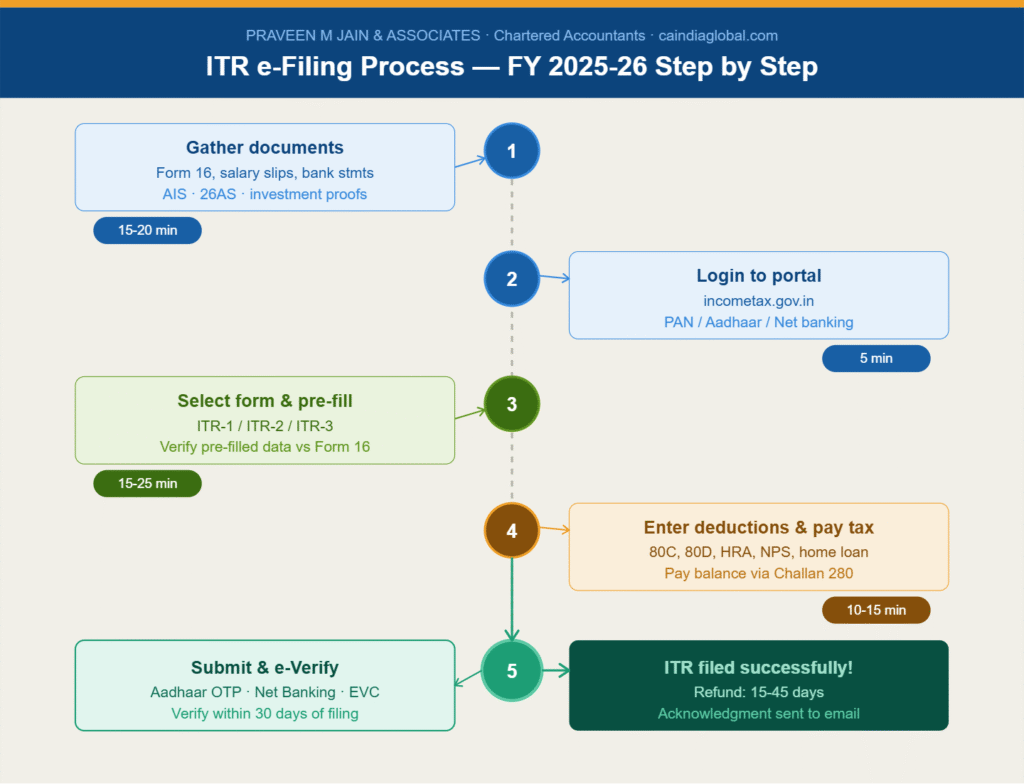
3. Step-by-Step E-Filing Process
Estimated total time: 45–90 minutes (first-time filers may take up to 2 hours).
Step 1 — Gather Your Documents (15–20 min)
- Download Form 16 (Part A + Part B) from your employer
- Collect bank statements for all accounts (Apr 2025 – Mar 2026)
- Download Form 26AS and AIS (Annual Information Statement) from the IT portal
- Collect investment proofs: 80C receipts, premium certificates, loan statements
- Note interest certificates from FDs, savings accounts, home loans
Step 2 — Register / Login to the Portal (5 min)
- Go to incometax.gov.in and login using your PAN, Aadhaar, or net-banking
- First-time filers: register using PAN as user ID
- Ensure your mobile number and email are linked to Aadhaar for OTP-based e-verification
Step 3 — Select the Filing Mode and Form (5 min)
- Navigate to: e-File > Income Tax Returns > File Income Tax Return
- Select Assessment Year: AY 2026-27
- Choose filing mode: Online (recommended) or Offline (download utility)
- Select your applicable ITR form (refer to Section 2 above)
Step 4 — Pre-Fill and Verify Data (15–25 min)
- The portal pre-fills salary, TDS, and financial transaction data from Form 26AS and AIS
- Verify every pre-filled entry against your Form 16 and bank statements
- Correct any discrepancies — mismatches can trigger scrutiny notices
- Enter additional income not captured in pre-fill (freelance, rent, etc.)
Step 5 — Claim Deductions and Compute Tax (10–15 min)
- Choose between Old Tax Regime and New Tax Regime (the portal will compute both)
- Enter all eligible deductions: 80C, 80D, HRA, home loan interest, NPS, etc.
- Cross-check the computed tax liability with your own calculation
Step 6 — Pay Tax Due (if any) (5–10 min)
- If there is any tax payable (after TDS), pay it as Self-Assessment Tax via Challan 280
- Enter the BSR code and challan serial number in the return before submitting
- Note: Interest under Section 234B/234C applies if advance tax was not paid
Step 7 — Submit and E-Verify (5 min)
- Preview the return carefully before submitting
- Submit the return — a success message and acknowledgment number (ITR-V) will appear
- E-Verify immediately: Aadhaar OTP (fastest), Net Banking, Bank EVC, or Demat EVC
- CRITICAL: E-verify within 30 days of filing; otherwise the return is invalid
4. Documents Checklist — Ready to Print
Keep all these documents handy before you start filing:
| DOCUMENT CHECKLIST — FY 2025-26 ITR FILING |
| IDENTITY & BASIC |
| PAN Card and Aadhaar Card (linked to mobile) |
| Bank account details (Account No, IFSC, Bank Name) for refund credit |
| INCOME DOCUMENTS |
| Form 16 Part A (TDS certificate from employer) and Part B (salary breakup) |
| Salary slips for April 2025 to March 2026 |
| Form 26AS downloaded from TRACES / IT portal |
| Annual Information Statement (AIS) downloaded from IT portal |
| Interest certificate from bank (savings, FD, RD) |
| Rental income receipts (if applicable) |
| DEDUCTION PROOFS |
| 80C: PPF passbook, ELSS statement, LIC premium receipt, tuition fee receipts, EPF statement |
| 80D: Health insurance premium receipt (self, spouse, children, parents) |
| Home Loan: Interest certificate from lender (for Section 24b deduction) |
| NPS: Contribution statement (80CCD(1B) — additional Rs. 50,000 deduction) |
| HRA: Rent receipts + landlord PAN (if annual rent exceeds Rs. 1 lakh) |
| OTHER |
| Capital gains statement from broker / mutual fund house (if any) |
| Previous year ITR copy (for continuity and carry-forward claims) |
| Challan 280 receipt if advance tax or self-assessment tax was paid |

5. Key Deductions & Exemptions for Salaried Employees
Section 80C — Up to Rs. 1,50,000 (Old Regime Only)
- EPF (Employee Provident Fund) contribution
- PPF (Public Provident Fund) deposits
- ELSS Mutual Funds (Equity Linked Savings Scheme)
- Life Insurance Premiums (LIC, term plans)
- Home Loan Principal Repayment
- 5-Year Tax-Saving Fixed Deposits
- Tuition Fees for children (up to 2 children)
- Sukanya Samriddhi Yojana / NSC / Senior Citizens Savings Scheme
Section 80D — Health Insurance Premiums
- Self, spouse, and dependent children: Up to Rs. 25,000
- Parents below 60 years: Additional Rs. 25,000
- Parents above 60 years (Senior Citizens): Additional Rs. 50,000
- Maximum total deduction: Up to Rs. 1,00,000 in qualifying scenarios
HRA — House Rent Allowance Exemption
- Exempt to the extent of least of: (a) Actual HRA received, (b) 50%/40% of salary (metro/non-metro), (c) Actual rent paid minus 10% of salary
- Proof required: Monthly rent receipts + landlord PAN if annual rent > Rs. 1 lakh
LTA — Leave Travel Allowance
- Available for domestic travel (air, rail, road) for self and family
- Exemption in a block of 4 years
- Only economy class airfare or AC first class rail fare is exempt
Home Loan Benefits
- Section 24(b): Interest deduction up to Rs. 2,00,000 per year (self-occupied property)
- Section 80C: Principal repayment up to Rs. 1,50,000 (within overall 80C limit)
NPS — National Pension System
- Section 80CCD(1): Included within 80C limit
- Section 80CCD(1B): Additional Rs. 50,000 over and above the Rs. 1,50,000 80C limit
- Section 80CCD(2): Employer’s NPS contribution (up to 10% of salary) — no upper limit
Standard Deduction
- Old Regime: Rs. 50,000 (from salary/pension, no proof required)
- New Regime: Rs. 75,000 (increased in Budget 2024)
6. How to Claim HRA — Detailed Guide
HRA is one of the most valuable exemptions for salaried employees in metro cities. Here is how to claim it correctly:
Eligibility Conditions
- You must be a salaried employee receiving HRA as part of your salary structure
- You must actually pay rent (not living in own house or parents’ house without rent agreement)
- Applicable only under the Old Tax Regime
HRA Calculation Example
Assume: Basic Salary = Rs. 6,00,000 | HRA Received = Rs. 2,40,000 | Annual Rent Paid = Rs. 1,80,000 | City: Mumbai (Metro)
- (a) Actual HRA received: Rs. 2,40,000
- (b) 50% of Basic Salary (Metro): Rs. 3,00,000
- (c) Rent paid – 10% of Basic: Rs. 1,80,000 – Rs. 60,000 = Rs. 1,20,000
HRA Exemption = Least of (a), (b), (c) = Rs. 1,20,000
Documents Required
- Monthly rent receipts (signed by landlord, with revenue stamp for receipts above Rs. 5,000)
- Rent Agreement / Leave & License Agreement
- Landlord’s PAN — mandatory if annual rent exceeds Rs. 1,00,000
- Declaration from landlord if landlord does not have PAN (Form 60)
Key Tips
- Submit rent receipts to your employer for Form 16 incorporation — reduces TDS at source
- If you forgot to submit proofs to your employer, you can still claim HRA exemption directly in your ITR
- Do not claim HRA if you are claiming home loan interest deduction on a self-occupied property in the same city
7. Tax-Saving Actionables
Actions Before 31 March (Year-End)
- Maximize Section 80C investments: top-up PPF, ELSS, or pay LIC premium
- Buy or renew health insurance to claim Section 80D
- Make voluntary NPS contribution for additional Rs. 50,000 under Section 80CCD(1B)
- Ensure rent receipts and agreements are in place for HRA claims
- Sell loss-making equity/MF units to harvest capital losses (tax loss harvesting)
Actions During Filing
- Compare tax under both Old and New Regime using the IT portal’s regime comparator
- Do not miss deductions your employer may not have considered (donations 80G, 80E — education loan interest)
- Ensure all bank accounts are reported, not just the salary account
- Report exempt income (PF receipts, dividends below threshold) even if not taxable
8. Top 10 Common Mistakes — and How to Avoid Them
| # | Mistake | How to Avoid |
| 1 | Not reconciling Form 26AS with Form 16 | Download and compare both before filing |
| 2 | Choosing the wrong ITR form | Check income sources carefully; use ITR-2 if you have capital gains |
| 3 | Missing the e-verification step | E-verify within 30 days using Aadhaar OTP — immediately after submission |
| 4 | Not reporting interest income | Include all interest: savings, FD, RD, P2P lending — it is taxable |
| 5 | Not reporting income from previous employer | Consolidate Form 16 from all employers; inform current employer for TDS computation |
| 6 | Ignoring AIS (Annual Information Statement) | Cross-check AIS for transactions you may have missed — tax dept tracks all |
| 7 | Claiming 80C deductions without proof | Keep physical/digital proofs for all claimed deductions |
| 8 | Not filing because all tax was deducted as TDS | Filing is mandatory even if TDS covers full liability — for refunds and compliance |
| 9 | Entering wrong bank account for refund | Double-check account number, IFSC, and pre-validate the bank account on the portal |
| 10 | Mixing Old and New Regime deductions | Under New Regime, most deductions (80C, HRA, LTA) are not available — do not claim them |
9. Penalties, Interest & Refund Timelines
Verify all applicable rates and deadlines on the official Income Tax portal (incometax.gov.in) as these may change with budget announcements.
Late Filing Penalty — Section 234F
- Filing after due date but on or before 31 December 2025: Penalty of Rs. 5,000
- If total income does not exceed Rs. 5 lakh: Penalty limited to Rs. 1,000
- If income is below the basic exemption limit: No penalty, but filing is still advisable
Interest on Unpaid Tax
- Section 234A: Interest at 1% per month on tax due if filed after due date
- Section 234B: Interest at 1% per month if advance tax paid is less than 90% of tax liability
- Section 234C: Interest for shortfall in quarterly advance tax instalments
Refund Timeline
- Typically 15 to 45 days after successful e-verification for straightforward returns
- Complex returns or mismatches may take longer — track at incometax.gov.in > My Account > Refund/Demand Status
- Ensure your bank account is pre-validated on the portal and linked to PAN for faster refund credit
10. DIY vs. Consult a CA — Making the Right Choice
| File It Yourself If… | Consult a CA (Like Us) If… |
| Single employer, simple salary income | Multiple employers or job changes during the year |
| No capital gains or business income | Equity/mutual fund capital gains or property sale transactions |
| All income covered by Form 16 | Freelance, consultancy, or rental income involved |
| Comfortable with IT portal navigation | IT notices, defective return notices received |
| No foreign assets or foreign income | ESOP/RSU taxation, foreign assets, or FEMA implications |
| No tax disputes or prior notices | High-value transactions, scrutiny risk, or prior year disputes |
11. Corporate Group ITR Filing — A Smarter Solution for Your Organisation
Managing ITR filing for hundreds of employees individually is inefficient, error-prone, and a significant compliance risk for your organisation. CA Praveen Jain & Associates offers a fully managed Corporate Group ITR Filing solution designed for forward-looking HR and Finance teams.
| 3 COMPELLING REASONS TO CHOOSE CORPORATE GROUP ITR FILING |
| 1. BULK EFFICIENCY & ACCURACY: We process 50 to 500+ employee returns simultaneously with a structured data collection workflow, payroll integration, and quality control at every stage — eliminating errors that cause TDS mismatches and notices. |
| 2. EMPLOYEE DELIGHT & RETENTION: Offer ITR filing as a premium employee benefit. We conduct on-site or virtual workshops, provide personalised tax-saving advisories, and ensure every employee maximises their take-home pay. |
| 3. CORPORATE COMPLIANCE AUDIT: We review your payroll structure, TDS compliance, Form 16 issuance, and advance tax workings — reducing your organisation’s exposure to penalties, interest, and departmental scrutiny. |
Our corporate clients benefit from a dedicated CA relationship manager, priority turnaround, and year-round advisory support — not just a one-time filing service.
DISCLAIMER
This article is for general informational and educational purposes only and does not constitute personalised tax advice. Tax laws, deadlines, and regulations are subject to change — always verify current rules and rates on the official Income Tax portal (incometax.gov.in) or consult a qualified Chartered Accountant before making any tax-related decisions