
Introduction: Why GST Litigation Is a Strategic Risk for SMEs
GST Litigation has quietly become one of the biggest operational and financial risks for Indian SMEs. What began as a compliance-driven tax regime has evolved into a data-led enforcement ecosystem, where mismatches, delays, and documentation gaps quickly escalate into GST Disputes. For small and medium enterprises, the cost is not just tax demand under GST, but blocked working capital, penalties, interest, and management bandwidth lost to litigation.
Most GST disputes do not arise from fraud. They stem from systemic issues—invoice mismatches, procedural lapses, misinterpretation of law, or vendor-side non-compliance. Once a show cause notice is issued, matters often proceed under Section 73 and 74 of the CGST Act, exposing SMEs to tax, penalty, and prolonged litigation before appellate authorities and GST tribunals.
This guide breaks down the Top 10 GST Litigation triggers, explains why they occur, what notices or evidence typically surface, and—most importantly—how SMEs can prevent disputes and defend their case effectively. Think of this as a litigation risk playbook for CFOs, founders, tax managers, and advisors.
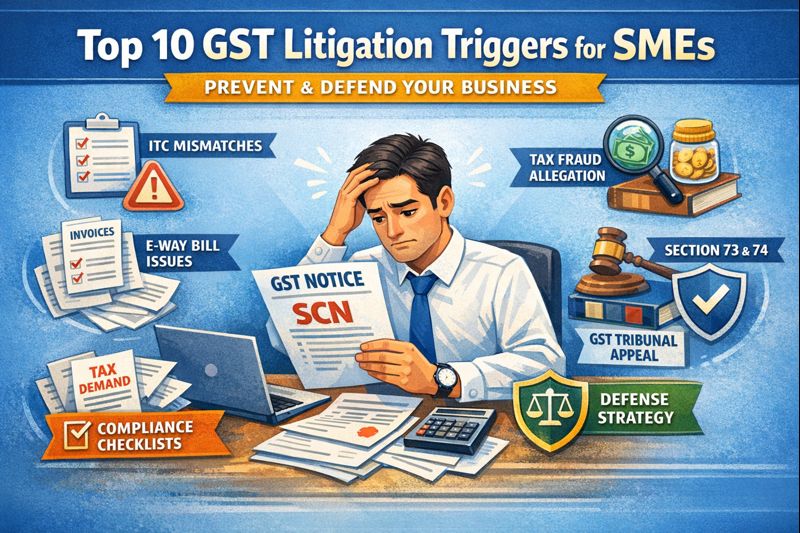
Top 10 Tax Litigation Triggers in GST (and How to Handle Them)
Understanding GST Litigation: A Growing Challenge for SMEs
Understanding the Impact of GST Litigation on SMEs
Understanding GST Litigation: Key Considerations for SMEs
1. Input Tax Credit (ITC) Mismatch with GSTR-2B
Why it causes litigation
ITC is the single largest driver of GST Disputes. Automated comparisons between GSTR-3B and GSTR-2B frequently flag mismatches due to vendor non-filing, delayed uploads, or incorrect invoice details. Tax authorities often treat these mismatches as excess credit claims, triggering scrutiny.
Many SMEs rely on supplier assurances rather than system-based reconciliation, which becomes problematic during GST assessment or audit.
Typical notice/evidence
- Automated mismatch intimation
- Scrutiny notice under Section 61
- Show cause notice (SCN) proposing ITC reversal
Preventive checklist
- Monthly GSTR-2B vs purchase register reconciliation
- Vendor compliance scorecard
- Contractual ITC protection clauses
- Periodic ITC ageing review
Defense strategies
- Prove eligibility and receipt of goods/services
- Demonstrate vendor follow-up and payment
- Seek relief under Section 73 (no fraud) where applicable
2. Excess ITC Claims on Blocked Credits
Why it causes litigation
Blocked credits under Section 17(5) remain a grey area, especially for expenses like employee benefits, motor vehicles, or mixed-use assets. SMEs often take aggressive positions without documented justification, leading to input tax credit denial during audit.
Interpretational ambiguity is frequently ignored until enforcement begins.
Typical notice/evidence
- Audit objection
- SCN proposing reversal with penalty and interest GST
Preventive checklist
- ITC eligibility matrix
- Expense-to-business nexus documentation
- Legal review of grey-area credits
Defense strategies
- Rely on beneficial interpretation
- Demonstrate business necessity
- Contest penalty under Section 73
3. Incorrect GST Classification (HSN/SAC Errors)
Why it causes litigation
Wrong classification leads to short payment of tax or excess ITC. SMEs often rely on legacy VAT or Service Tax classifications without revisiting GST-specific rate schedules.
Once identified, classification disputes frequently escalate into prolonged litigation.
Typical notice/evidence
- Rate mismatch notices
- Tax demand under GST with interest
Preventive checklist
- Annual classification review
- Written classification opinions
- Invoice consistency checks
Defense strategies
- Advance ruling references (illustrative)
- Industry practice documentation
- Challenge invocation of Section 74
4. Non-Reversal of ITC on Credit Notes
Why it causes litigation
Credit notes issued post-supply require proportionate ITC reversal. Many SMEs miss reversals due to timing differences or accounting oversight, leading to alleged excess credit.
Typical notice/evidence
- GSTR-1 vs GSTR-3B mismatch
- Audit para on excess ITC
Preventive checklist
- Credit note reconciliation tracker
- ERP-linked ITC reversal controls
Defense strategies
- Demonstrate timing mismatch
- Voluntary reversal to reduce penalty exposure
5. Delayed or Incorrect GST Returns
Why it causes litigation
Late or incorrect filings create red flags in the GST system. Repeated delays often result in best judgment GST assessment and system-generated tax demands.
Typical notice/evidence
- Best judgment order under Section 62
- Late fee and interest notices
Preventive checklist
- Compliance calendar with alerts
- Maker-checker return review
Defense strategies
- File pending returns promptly
- Seek withdrawal of assessment
🔔 Mid-Article CTA
Facing GST notices or compliance stress? Schedule a GST Litigation Advisory to identify risks early and plan corrective action before matters escalate.
6. E-Way Bill and Movement Documentation Errors
Why it causes litigation
Mismatch between invoice and e-way bill details often results in detention and penalties. Minor clerical errors escalate quickly under enforcement drives.
Typical notice/evidence
- MOV series notices
- Penalty orders under Section 129
Preventive checklist
- Pre-dispatch verification
- Transporter coordination SOPs
Defense strategies
- Prove clerical nature of error
- Seek waiver of penalty
7. Related Party and Valuation Disputes
Why it causes litigation
Transactions between related entities attract valuation scrutiny. Tax officers often allege undervaluation to raise GST disputes.
Typical notice/evidence
- Valuation SCN
- Transfer pricing style comparisons
Preventive checklist
- Arm’s length documentation
- Consistent pricing policies
Defense strategies
- Rule 28 compliance
- Commercial rationale evidence
8. Wrong Refund Claims or Inverted Duty Structure
Why it causes litigation
Refunds are heavily scrutinized. Minor documentation gaps lead to rejection and appellate litigation.
Typical notice/evidence
- Refund deficiency memo
- SCN proposing rejection
Preventive checklist
- Refund documentation checklist
- Pre-filing review
Defense strategies
- Rectify deficiencies
- Appeal before GST tribunal/appeal authority
9. Allegations of Suppression or Fraud (Section 74)
Why it causes litigation
Authorities often invoke Section 74 mechanically to impose penalties, even when disputes are interpretational.
Typical notice/evidence
- SCN alleging suppression
- 100% penalty proposal
Preventive checklist
- Transparent disclosures
- Written legal positions
Defense strategies
- Push reclassification to Section 73
- Challenge mens rea allegation
10. Poor Response to Show Cause Notices
Why it causes litigation
Many SMEs underestimate the importance of a structured reply. Weak responses result in adverse orders that are harder to reverse on appeal.
Typical notice/evidence
- Adjudication order
- Recovery proceedings
Preventive checklist
- SCN tracking system
- Professional drafting support
Defense strategies
- Comprehensive factual rebuttal
- Natural justice arguments
Conclusion: Litigation Prevention Is Better Than Cure
GST Litigation is no longer an exception—it is a predictable outcome of weak systems, poor documentation, or reactive compliance. For SMEs, the smartest strategy is not firefighting notices but building litigation resilience through reconciliations, internal controls, and timely legal intervention.
When disputes arise, early classification of issues under Section 73 and 74, evidence-led replies, and strategic appeals can significantly reduce exposure. GST compliance for SMEs must now be viewed as a risk management function, not just a filing exercise.
A proactive approach protects cash flows, preserves credibility with tax authorities, and avoids years of avoidable GST disputes.