
Foreign Assets in AIS:A new compliance development in 2026 makes foreign-asset reconciliation more important than ever. The Income Tax Department has enabled taxpayers to view Foreign Asset Information received under CRS/FATCA through AIS, giving taxpayers greater visibility into information that may already be available to the Department before or during ITR filing. The Department formally highlighted this facility in July 2026.
Foreign Assets in AIS can expose critical ITR mismatches. Learn Schedule FA, CRS/FATCA, penalties and essential AY 2026-27 compliance steps.

For a Resident and Ordinarily Resident (ROR), the practical question is no longer simply “Did I report my foreign income?” It is:
Does the foreign information available to the Department reconcile with my Schedule FA, Schedule FSI, Schedule TR, Form 67 and underlying records?
This guide explains how to perform that reconciliation for AY 2026-27 and how to deal with discrepancies without assuming that every AIS figure must exactly equal an ITR figure.
Jump to
- Quick summary
- What is AIS 2026?
- Schedule FA
- Reconciliation procedure
- Common mismatches
- Penalties and timelines
- CRS/FATCA
- Templates
- FAQs
- Next steps
Quick summary — who must care and why
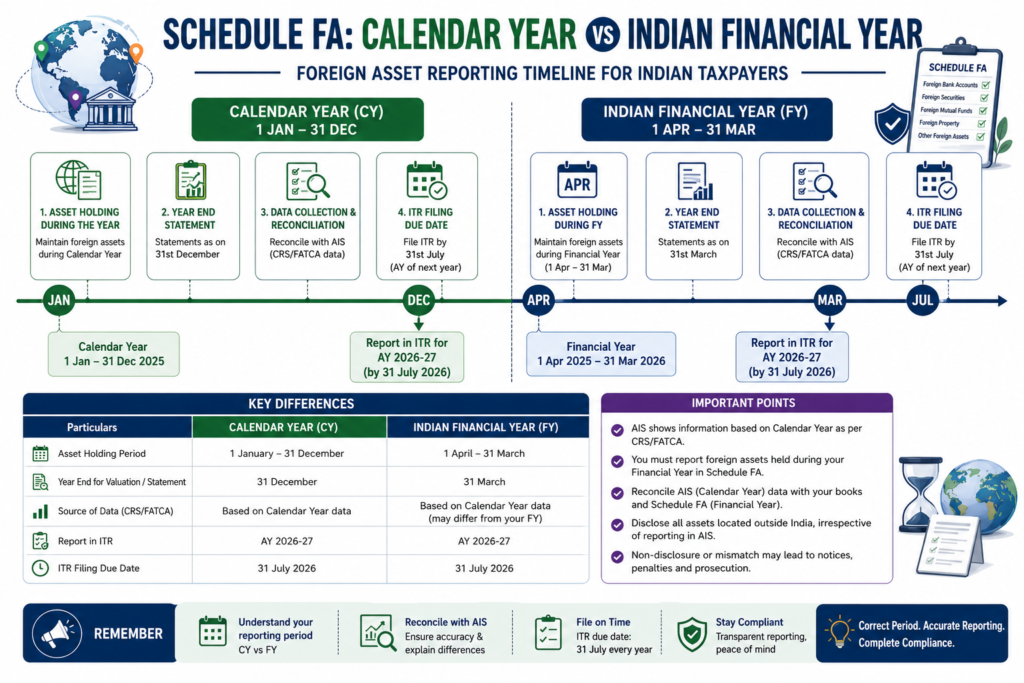
If you are an ROR taxpayer with an overseas bank account, brokerage account, foreign shares, RSUs/ESOPs, insurance policy, overseas property, trust interest or another foreign asset, Schedule FA deserves a separate compliance review. Schedule FA uses a calendar-year reporting period, while most Indian income-tax computation is based on the financial year. The Department now also displays foreign-asset information received through CRS/FATCA in AIS, making reconciliation increasingly important.
What is AIS 2026 and how it reports foreign assets
The Annual Information Statement (AIS) is designed as a comprehensive view of information available with the Income Tax Department. It includes information from sources such as TDS/TCS, SFT, tax payments and other information. The Department expressly cautions that AIS is not necessarily a complete record of every transaction and taxpayers remain responsible for reporting complete and accurate information in the ITR.
In July 2026, CBDT announced that taxpayers can view Foreign Asset Information under CRS/FATCA in AIS. This is particularly relevant to taxpayers with overseas financial accounts and investments because information received through international exchange mechanisms can now be visible to the taxpayer as part of the Department’s compliance ecosystem.
Key AIS fields related to foreign assets
Depending on the information received, foreign information can relate to items such as:
- Foreign financial accounts
- Account balances or values
- Interest
- Dividends
- Gross proceeds or other payments
- Financial investments
- Foreign-source income
- Other information received under international exchange arrangements
Important: AIS data is an information signal, not automatically the taxable figure for the ITR.
For example, a foreign broker may report gross sale proceeds, whereas the Indian ITR reports the taxable capital gain after applying the applicable computation rules.
Similarly, a foreign account may contain principal/capital contributions as well as taxable interest. Comparing the total account movement with taxable income will therefore produce misleading results.
The Department’s AIS guidance also provides an online feedback facility where reported information can be challenged or clarified. link:
https://www.incometax.gov.in/iec/foportal/help/all-topics/e-filing-services/ais-annual-information-statement?utm_source=chatgpt.com
Schedule FA in the ITR
Foreign Assets in AIS:Schedule FA is the principal foreign asset disclosure schedule for applicable resident taxpayers. The Income Tax Department’s current Schedule FA guidance covers foreign depository and custodial accounts, foreign equity/debt interests, insurance or annuity contracts, overseas entities, immovable property, other capital assets, signing authority, trusts and other foreign-source income.
For AY 2026-27, the Schedule FA forms specifically refer to assets/accounts held during the calendar year ending 31 December 2025.
Who generally needs to fill Schedule FA?
The principal population is resident taxpayers who hold, own or have a beneficial interest in foreign assets or have foreign-source income. The Department’s guidance says Schedule FA need not be filled by an RNOR or non-resident, subject to the specific exceptions in the ITR instructions—for example, the special treatment of certain assets acquired by non-Indian citizens while they were non-resident.
This is why residential status must be determined before completing Schedule FA.
Line-by-line: how to fill Schedule FA
| Table | What it covers | Key information |
|---|---|---|
| A1 | Foreign depository accounts | Bank, country, account number, status, opening date, peak balance, closing balance, gross interest |
| A2 | Foreign custodial accounts | Custodian/broker, account details, peak/closing values and relevant income/credits |
| A3 | Foreign equity/debt interest | Entity, nature of interest, holding date, investment value, income and taxable amount |
| A4 | Foreign insurance/annuity contracts | Institution, contract date, cash/surrender value and gross amount paid/credited |
| B | Financial interest in foreign entity | Entity details, direct/beneficial ownership, investment cost and income |
| C | Overseas immovable property | Country, address, ownership, acquisition date, cost and income |
| D | Other foreign capital assets | Asset type, ownership, acquisition date, cost and income |
| E | Signing authority | Institution/account, peak investment/balance and income |
| F | Foreign trusts | Trust, trustees, settlor, beneficiaries and taxpayer’s position |
| G | Other foreign-source income | Source, nature and amount of income |
These fields are reflected in the AY 2026-27 ITR forms notified by CBDT.
Example 1: Resident Indian with foreign bank interest
Suppose an ROR taxpayer maintained a US bank account throughout 2025 and earned USD interest.
The compliance chain is:
Foreign bank account → Schedule FA → interest in the relevant income schedule → Schedule FSI → Form 67/Schedule TR where foreign tax credit is claimed.
The account disclosure and income disclosure are related, but they are not the same disclosure.
Example 2: Overseas property sale
An Indian ROR sells a Dubai property during FY 2025-26.
The transaction may require:
- Historical foreign asset disclosure in Schedule FA for the relevant reporting period.
- Capital-gain computation under the applicable Indian rules.
- Reporting of foreign-source income in Schedule FSI where applicable.
- Foreign tax credit analysis under the relevant DTAA or section 91.
- Form 67 and Schedule TR where credit is claimed.
Example 3: Foreign mutual funds or US-listed investments
A taxpayer holding foreign ETFs, shares or mutual-fund interests should distinguish:
- The broker/custodial account;
- The underlying investment;
- Dividends/interest;
- Sale proceeds;
- Taxable capital gains; and
- Foreign tax withheld.
Do not treat the broker’s gross proceeds as equivalent to taxable capital gains.
Reconciliation procedure — how to reconcile AIS with ITR
A robust reconcile AIS with ITR process should be performed before filing and retained as a workpaper.
8-step reconciliation checklist
1. Confirm residential status
Determine whether the taxpayer is Resident, RNOR or Non-Resident for FY 2025-26. Do not begin Schedule FA preparation before completing this step.
2. Download the complete foreign records
Obtain:
- Foreign bank statements
- Brokerage/custodian statements
- Foreign shares/ETF statements
- RSU/ESOP vesting records
- Foreign insurance statements
- Property purchase/sale documents
- Trust documents
- Foreign tax certificates
- Overseas tax returns, where relevant
- FEMA/LRS/ODI records where relevant
3. Separate the reporting periods
Create two folders:
- CY 2025 — Schedule FA
- FY 2025-26 — income/tax computation
This is one of the most important controls because Schedule FA operates on the relevant calendar-year period, whereas income reporting generally follows FY 2025-26.
4. Map ownership
For every asset identify:
- Legal owner
- Beneficial owner
- Beneficiary
- Joint holder
- Signing authority
- Trustee/settlor relationship
Schedule FA expressly captures beneficial interests and beneficiary positions.
5. Reconcile foreign currency
Maintain a dated FX working paper. Schedule FA guidance uses the SBI Telegraphic Transfer Buying Rate (TTBR) for relevant conversions. The applicable date depends on the figure being converted—for example, peak balance/value, investment date or relevant closing date.
6. Reconcile income separately
Map:
Foreign statement → taxable income → ITR income schedule → Schedule FSI → foreign tax credit → Schedule TR/Form 67
7. Compare with AIS
Do not force a mathematical match where the underlying concepts differ.
Instead classify each difference as:
- Timing difference
- Gross vs net difference
- FX conversion difference
- Principal/capital movement
- Income already reported elsewhere
- Duplicate reporting
- Incorrect third-party information
- Asset not appearing in AIS but independently reportable
8. Document the conclusion
For every material mismatch, retain a one-line explanation and supporting evidence.
Common mismatches & how to resolve AIS-ITR differences
Mismatch 1: AIS shows a foreign account but Schedule FA does not
First verify:
- Was the taxpayer ROR?
- Was the account held during CY 2025?
- Is the account legally/beneficially connected to the taxpayer?
- Is it a duplicate or incorrectly attributed record?
If genuine, Schedule FA should be reviewed immediately.
Mismatch 2: AIS shows USD 100,000 but ITR shows a much smaller amount
This could be entirely explainable.
For example:
- AIS: gross sale proceeds = USD 100,000
- Cost of acquisition = USD 80,000
- Indian taxable capital gain = USD 20,000
The figures measure different things.
Mismatch 3: AIS shows interest but ITR shows a different INR amount
Check:
- Foreign-currency amount;
- Relevant reporting date;
- Conversion methodology;
- Whether the AIS figure is gross;
- Whether foreign withholding tax was deducted.
Sample explanation for a tax notice
“The foreign financial account reflected in the information available with the Department has been reconciled with the taxpayer’s foreign bank/custodial statement. The amount reflected in the third-party information represents [gross balance/gross proceeds/interest], whereas the amount reported in the return represents [taxable income/capital gain/converted amount] computed under the applicable provisions. A transaction-wise reconciliation and supporting statement are enclosed.”
For an incorrect AIS entry:
“The taxpayer has reviewed the information and submits that the reported transaction does not pertain to the taxpayer. Supporting identification/account records are enclosed. Appropriate feedback has also been submitted through the AIS facility, wherever available.”
Do not use a generic explanation without verifying the underlying statement.
Compliance risks, penalties and timelines
The foreign-asset regime is particularly important because Schedule FA disclosure is connected with the Black Money (Undisclosed Foreign Income and Assets) and Imposition of Tax Act, 2015.
Section 43 — omission/inaccurate particulars
Section 43 provides for a ₹10 lakh penalty where a qualifying resident fails to furnish information or furnishes inaccurate particulars relating to foreign assets/income in a return. Following the 2024 amendment, the penalty provision does not apply to assets other than immovable property where the aggregate value does not exceed ₹20 lakh.
That ₹20 lakh figure should not be misunderstood as a general foreign-asset reporting threshold. The safer compliance approach is to make the required disclosure even where a penalty-relief provision may apply.
Section 42 — failure to furnish the return
Section 42 separately addresses failure to furnish a return in specified circumstances involving foreign assets, foreign income or financial interests and also provides a ₹10 lakh penalty, subject to its statutory proviso.
Tax and penalty on undisclosed foreign income/assets
The Black Money Act separately provides for taxation of undisclosed foreign income/assets and penalties. A taxpayer facing a historical non-disclosure should therefore not assume that filing the next year’s Schedule FA automatically cures the earlier default.
Limitation is fact-specific
A blanket statement such as “the Department can go back exactly X years” is unsafe.
For assessment/reassessment under the Black Money Act, section 11 contains a specific limitation framework. In a March 2026 Mumbai ITAT decision, Sunil Kumar Alagh v. DDIT, the Tribunal examined section 10/section 11 and held that the assessment in that particular case was time-barred, emphasising the statutory two-year completion period from the end of the financial year in which the section 10(1) notice was issued, subject to statutory exclusions.
The limitation analysis can change depending on the proceeding, notice date, exchange-of-information period, stay and other statutory exclusions. Past foreign-asset omissions should therefore be reviewed year-by-year by a professional.
AY 2026-27 filing timelines
For AY 2026-27:
- ITR-1/ITR-2 taxpayers: 31 July 2026
- Non-audit business/profession cases: 31 August 2026
- Audit cases: generally 31 October 2026
- Transfer-pricing cases: generally 30 November 2026
- Belated return: 31 December 2026
- Revised return: 31 March 2027, subject to applicable conditions and fees.
As of 12 August 2026, taxpayers should not assume that a further extension will be granted.
2026 FAST-DS development
Budget 2026 also introduced the Foreign Assets of Small Taxpayers Disclosure Scheme, 2026 (FAST-DS). The Finance Bill provides a one-time framework for eligible taxpayers to disclose specified historical foreign income/assets subject to prescribed conditions, with immunity from further tax, penalty and prosecution under the Black Money Act after compliance with the scheme.
Crucial: the scheme requires implementation through the prescribed mechanism and commencement notification. It should not be treated as an excuse to delay current-year Schedule FA compliance.
CRS, FATCA and Automatic Exchange of Information
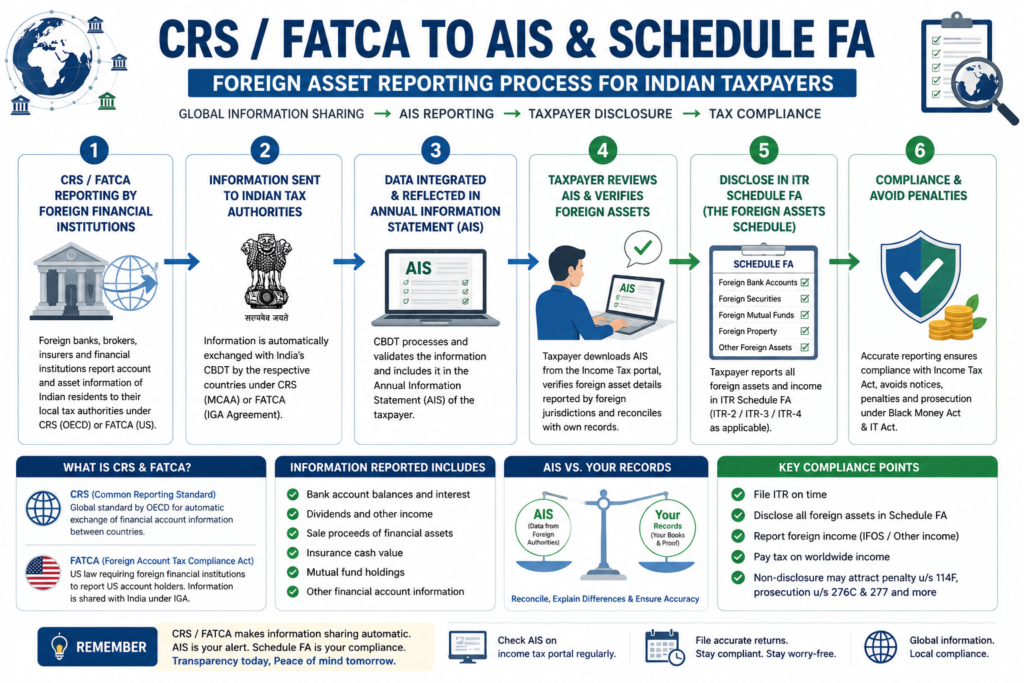
The reason foreign-asset compliance is becoming more visible is international information exchange.
Under the OECD’s Common Reporting Standard (CRS), participating jurisdictions collect financial-account information from reporting financial institutions and exchange relevant information automatically with other jurisdictions on an annual basis.
India has incorporated CRS reporting requirements into its domestic framework, including Rules 114F–114H and reporting mechanisms applicable to Reporting Financial Institutions.
FATCA separately supports information exchange relating to US reportable accounts.
What this means for taxpayers
A foreign account can therefore generate multiple compliance footprints:
Foreign financial institution → CRS/FATCA reporting → Indian tax administration → AIS/Compliance systems → ITR/Schedule FA reconciliation
This does not mean every AIS entry is necessarily correct. It does mean taxpayers should no longer treat an offshore asset as invisible merely because:
- No income was earned;
- The account is dormant;
- The asset value is small;
- The asset was inherited;
- The investment was made years ago;
- The broker did not deduct Indian tax; or
- The asset does not currently appear in AIS.
Practical templates and tools
AIS–Schedule FA reconciliation table
| Asset/account | Country | AIS amount | CY 2025 statement | Schedule FA | FY income | FSI/TR/Form 67 | Difference/reason |
|---|---|---|---|---|---|---|---|
| Bank account | US | $XX | $XX | A1 | ₹XX interest | FSI | FX/timing |
| Brokerage account | US | $XX | $XX | A2 | — | — | Balance methodology |
| Foreign shares | US | $XX proceeds | $XX | A3 | ₹XX gain | FSI | Gross vs gain |
| Property | UAE | — | — | C | ₹XX rent/gain | FSI | Not in AIS |
| Trust | UK | $XX | $XX | F | ₹XX | FSI/TR | Beneficial interest |
FX working-paper format
| Date | Currency | Purpose | Foreign amount | SBI TTBR | INR amount | Evidence |
|---|---|---|---|---|---|---|
| Acquisition date | USD | Investment cost | $XX | ₹XX | ₹XX | SBI rate record |
| Peak date | USD | Peak value | $XX | ₹XX | ₹XX | Statement + rate |
| 31 Dec 2025 | USD | Closing value | $XX | ₹XX | ₹XX | Statement + rate |
The Schedule FA conversion methodology should be documented using the applicable SBI TT buying rate rather than an arbitrary online currency rate.
Documents to keep ready
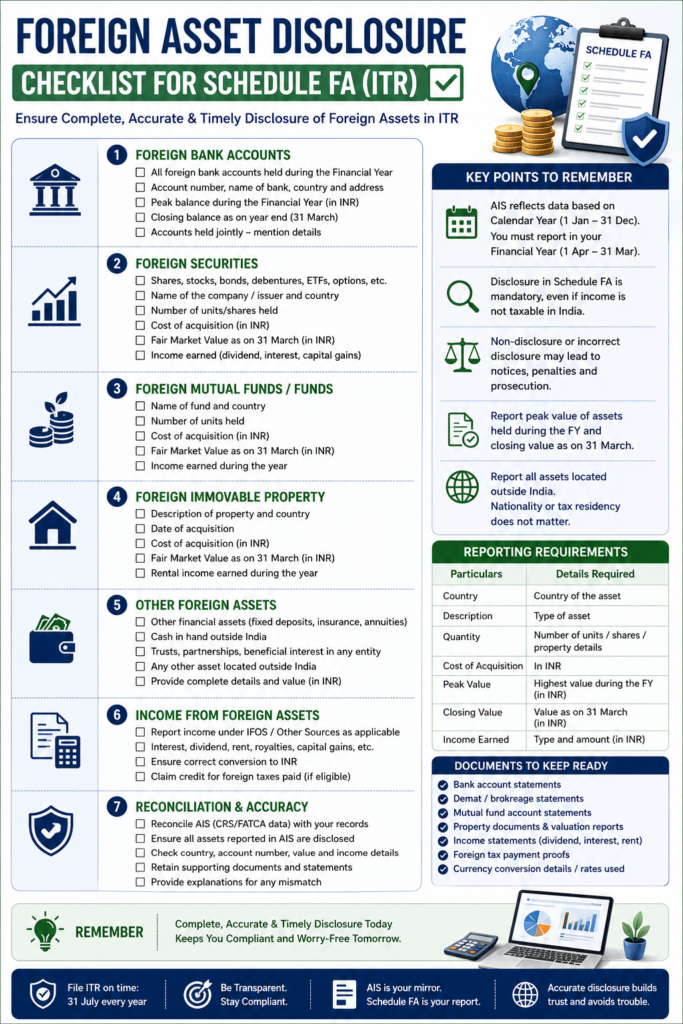
- Passport/travel history for residential-status determination
- Foreign bank statements
- Foreign brokerage/custodian statements
- RSU/ESOP vesting statements
- Share purchase/sale confirmations
- Foreign dividend/interest certificates
- Foreign tax withholding certificates
- Property purchase/sale agreements
- Foreign insurance statements
- Trust deeds/beneficiary documentation
- Previous ITRs and Schedule FA
- AIS and Foreign Asset Information reports
- Schedule FSI/TR/Form 67 workings
- SBI TTBR evidence
- FEMA/LRS/ODI records where relevant
FAQs
1. Do all taxpayers with foreign assets have to file Schedule FA?
Not universally. Schedule FA is principally relevant to applicable resident taxpayers. RNORs and non-residents generally do not fill it, subject to specific exceptions in the ITR instructions.
2. Is ₹20 lakh a threshold below which foreign assets need not be disclosed?
No. The ₹20 lakh provision is a statutory exception to the section 43 penalty for specified non-immovable assets. It should not be treated as a general disclosure threshold.
3. Does a dormant overseas bank account need to be reported?
If it falls within the taxpayer’s applicable Schedule FA reporting obligation and was held during the relevant reporting period, its dormancy does not by itself remove the disclosure requirement.
4. Do foreign shares received as RSUs/ESOPs need Schedule FA disclosure?
Foreign equity interests can fall within Schedule FA. The taxpayer should separately consider the tax treatment of the employment perquisite, subsequent dividends and capital gains.
5. I have foreign income but no foreign asset. What then?
Foreign-source income may still need to be reported through the applicable income schedule and Schedule FSI. Schedule FA’s Table G also addresses certain foreign-source income not otherwise covered by Tables A-F.
6. I am an NRI. Do I have to disclose my foreign bank account?
Generally, a non-resident does not fill Schedule FA. However, residential status must be established under section 6 for the relevant year; citizenship alone does not decide the issue.
7. Does inheritance remove the Schedule FA obligation?
No. The source of acquisition and taxability are separate questions from disclosure. An inherited foreign property, account or financial interest may still require disclosure where the taxpayer falls within the applicable Schedule FA regime.
8. What about a foreign gift?
A foreign gift may need to be disclosed depending on the asset and taxpayer’s status. Separately determine its taxability under the applicable gift provisions, source documentation and relationship exemptions. Do not assume “gift” means “no reporting”.
9. Why does my AIS show more than my ITR?
AIS may contain gross transactions, account balances, proceeds or third-party information, while the ITR may report taxable income after applying Indian computation rules. Timing and FX differences can also arise. The answer is reconciliation—not blindly copying AIS.
10. What if my foreign asset is missing from AIS?
Do not treat absence from AIS as an exemption from Schedule FA. The Income Tax Department itself says AIS contains information presently available to it and taxpayers must report complete and accurate information independently.
Compliance checklist before submitting AY 2026-27 ITR
Before clicking “Submit”, confirm:
- Residential status is correctly determined.
- CY 2025 foreign-asset statements are obtained.
- All foreign bank accounts are mapped.
- Brokerage/custodial accounts are mapped.
- Foreign shares, ETFs and RSUs/ESOPs are mapped.
- Foreign insurance/annuity contracts are reviewed.
- Overseas property is reviewed.
- Foreign trust interests are reviewed.
- Beneficial ownership and signing authority are checked.
- Schedule FA values are supported by working papers.
- SBI TTBR conversion records are retained.
- Foreign interest/dividends are reported correctly.
- Foreign capital gains are separately computed.
- Schedule FSI is reconciled.
- Schedule TR/Form 67 is reconciled where FTC is claimed.
- AIS/Foreign Asset Information is reviewed.
- Every material mismatch has a documented explanation.
- Past-year omissions are escalated to a tax professional rather than silently rolled into the current return.
Next steps
The new visibility of foreign information in AIS makes Foreign Assets in AIS a practical reconciliation issue—not merely an ITR-formality issue.
If you have foreign shares, overseas bank accounts, RSUs/ESOPs, foreign property, trusts or other offshore interests, do not wait for a notice to discover a mismatch.
Praveen M Jain & Associates can assist with foreign-asset disclosure, international tax compliance, Schedule FA/FSI/TR reconciliation, foreign tax credit, FEMA-related advisory and income-tax notice/assessment representation.